

How can a child suffering from the Legg-Calvé-Perthes disease continue to physically practice regularly? In this article, we received the account of Aurélien who looked for an adapted solution to this problem for his son Sacha.
What is the Legg-Calvé-Perthes disease?
The Legg-Calvé-Perthes disease (or LCPD) is an illness which occurs in children who are between 3 and 10 years old. What happens is that the upper end of the thigh’s bone (the femoral head) is not irrigated correctly anymore. This causes the bone’s necrosis at the hip which is reversible. Fortunately, after a period when the femoral head warps, blood circulation comes back progressively. This allows the bone to rebuild itself and to spontaneously heal. Despite that, the femoral head must correctly readjust in the pelvis cavity. The healing process is long, it can take from 18 months to 3 years.
LCPD symptoms are the beginning are often limping and hip pain. The symptoms can also include:
- Pain in the knee, thigh or groin;
- Hip stiffness which affects the way the child walks;
- Reduction of the range of motion of the hip;
- Mechanical pain due to the movement of the lower limbs.
Generally, the child suffers from hip stiffness and this can affect the way they walk.
A pelvis X-ray allows to view the changes in the femoral head. To confirm the diagnosis, the doctor can also prescribe an MRI and an ultrasound on the hip.
In some cases, a surgical operation is necessary to replace the bones of the hip. But most of the time, the treatment is based on:
- Suppression of the support of the lower limbs;
- Medical monitoring and physiotherapy sessions.
We have had the occasion to talk about Aurélien, who talked about his son Sacha who has been diagnosed with the Legg-Calvé-Perthes disease in 2023. Here is his account.
Legg-Calvé-Perthes disease: Sacha’s story
Practising a sport despite the disease
Sacha is an 8-year-old boy and he is very sporty. He has been playing in a football club since he was 5. He also bikes, skies, and plays handball. He started to limp and was feeling pain in his hip. In July 2023, the doctor diagnosed him with the Legg-Calvé-Perthes disease.
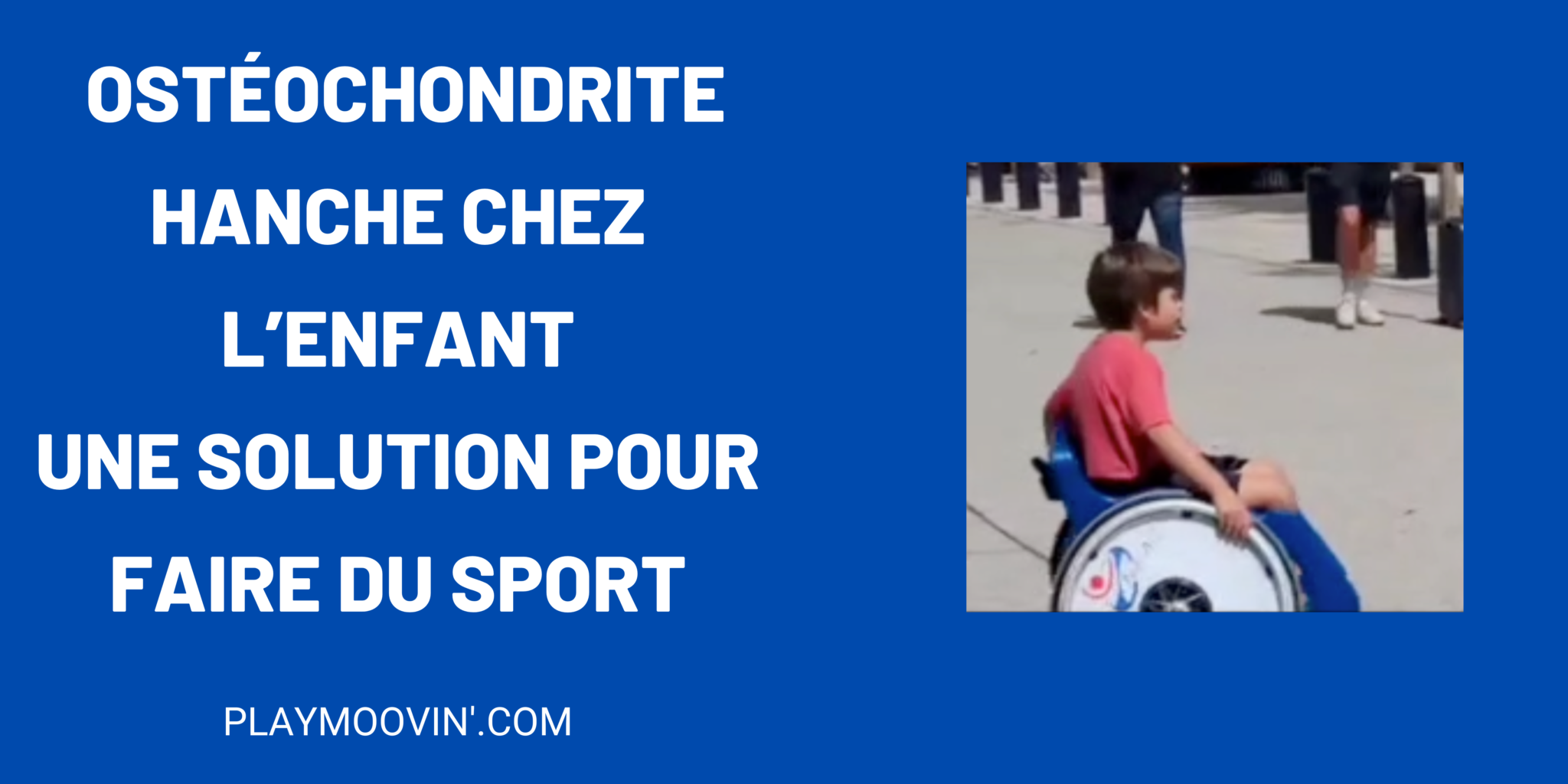
He will be able to recover his full mobility in 2 to 3 years. But for now, Sacha is not allowed to walk, to jump or to run. His dad explains: “I’ve looked on the Internet for an alternative so that he could keep practicing sport. And I found out that PlayMoovin’ made a sport plastic wheelchair – the KidsMoovin’ – which allows children to practice a sport despite their inability to walk.
So, I quickly contacted Sébastien, one of the managers. I took two wheelchairs, one for my son and one for me because there is also an adult version of the wheelchair: the FreeMoovin’. Nowadays we regularly play on the plaza not far from home. We race, we play wheelchair basketball, wheelchair handball, etc.
At school, Sacha can swim and bike. But because he has his sport wheelchair, he can also go in the playground with the other children. I also suggested the town council to invest in a sport wheelchair to help raise awareness of disabilities.”
What do you think of the sport wheelchair?
Here is what Aurélien told us about PlayMoovin’s sport wheelchair: “To be fully honest, the wheelchair was of tremendous help from the start. We wish to do everything we can so that things go for the best. We do not want him to see his disease as an obstacle preventing him from doing things but rather as an opportunity to explore other ways to move. And we have a lot of fun! As soon as I talked about the wheelchair, Sacha was seduced by the playful aspect of using it. Instead of giving up on running, we went full steam ahead on the wheelchairs!
Sacha managed to handle the wheelchair without any troubles, it is very easy. However, it remains a sport wheelchair so he cannot use it within the house. It becomes difficult to move with it when the surface is not flat anyway. It is way more rigid compared to his classic wheelchair so it is an excellent option to play. In short, Sacha loves his wheelchair and I recommend it to all the parents who are in the same case.”
If your child suffers from the Legg-Calvé-Perthes disease or from any other incapacitating illness, there are solutions so that they can keep practicing sports with their family or friends. Contact us if you want to know more!


