

Wheelchair basketball: overview
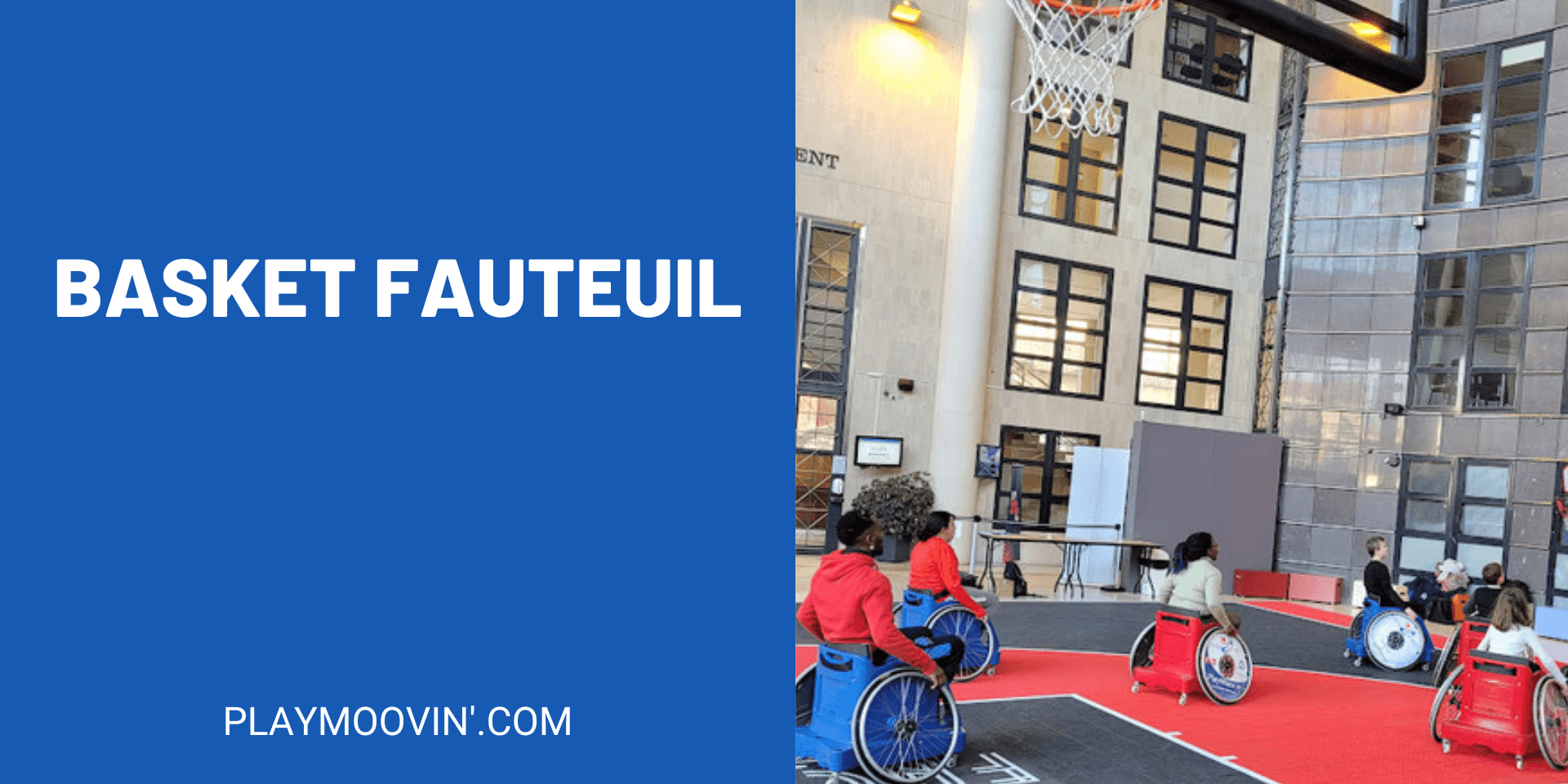
Today PlayMoovin’ decided to focus on wheelchair basketball. This parasport practice is an inclusive team sport. Let us explore the origins of this sport and learn about the rules.
History of the sport
Wheelchair basketball was created in the USA during the second world war. Wounded soldiers from the war played it regularly. As early as 1955, two French rehabilitation centres started to integrate it into their activities. This sport discipline is played in more than 100 countries in the world. It allows to surpass oneself while displaying talent and determination.
Wheelchair basketball was created for people suffering from a motor or a neurological disability or from a cerebral paralysis. It is also opened to other types of disabilities for leisurely practice. Find out about the rules of wheelchair basketball below.
Wheelchair basketball: rules to know
Basket height and playground dimensions
The pitch has the same dimensions as a standard basketball playground. It is 15 by 28 meter long. The basket is 3.05-meter-high like in the traditional game. The 3-point line stays the same.
Game time
Wheelchair basketball rules are quite similar to more traditional basketball rules. Two teams of 5 players are opposed for 4 periods of 10 minutes each. The objective is to score the most baskets within the game time.
Double dribble and free throw
Wheelchair basketball rules are clear: players cannot move forward without dribbling or keep the ball on their knees. If they do not respect these rules, it will be considered a foul.
After they roll twice, players have to do one of the two following things:
- bounce the ball off the ground
- pass it to a team member
For free throws, the basketball players must keep the back wheels of their wheelchair behind the line.
Everything is a matter of strategy to score first!
Classification in wheelchair basketball
The rules impose that players are evaluated depending on the importance of their disability. They are classified according to a point system that goes from 1 to 4.5.
Within a team, the point total on the playground cannot exceed 14.5 points. This guarantees equality between the teams.
Necessary equipment to play wheelchair basketball
A multisport wheelchair is perfectly fit to practice wheelchair basketball in a leisurely way. For this purpose, go for a robust but light model.
The FreeMoovin’ allows for a beginner-friendly leisure basketball practice. This anti-swing wheelchair is made of hard plastic and was conceived in France. It is equipped with security elements near the knees and the feet. The cherry on top is that it is 6 times cheaper as a professional wheelchair.
For an elite athlete however, the rules regarding the wheelchair are well-specified. The wheels cannot have a diameter that goes over 69cm.
Moreover, the seat must be:
- 58cm-high for players that have a score between 3.5 and 5 points;
- 63cm-high for players that have a score between 1 and 3 points.
Finally, the safety bar must be 11 meter-high compared to the ground.
Wheelchair basketball competitions
In France, competitions are organised by the French parasport federation. Wheelchair basketball games are a dynamic show, in which adrenaline meets excellence.
The French Championship is composed of 3 leagues. There are:
- 5 teams in Nationale 1
- 17 teams in Nationale 2
- 3 teams in Nationale 3
Every 2 years, the international basketball federation organises the world championship. In addition to that, wheelchair basketball also has a prominent place within the paralympic games.
You now know about the main rules of wheelchair basketball. This sport is much more than just a practice adapted to people suffering from a disability.
It is an inclusive sport par excellence and it contributes to the fight against the discriminations related to disabilities.
Do you want to get things moving by raising awareness among children and adults? We rent sport wheelchairs so if you want to commit to this cause and help us shatter the barriers between people, call us! Also, you can find out about the other sports that one can practice with a wheelchair.