

Do you want to know more about adaptive sport? Here is a list which indexes the main physical activities that can be practiced by people suffering from a physical or a psychological disability.
In short: adaptive sport in France
Adaptive sport is a sport practice intended for people suffering from a mental or psychological disability. As a reminder, sport is a right for everyone as stated by “la loi sur le handicap” (disability act) from the 11th of February 2005.
As of today, 70% of people suffering from disabilities are interested in practicing a physical activity. However, only 47% of them do practice a physical activity.
To reverse the trend, the government wanted to strengthen the place of sport in France. The national sport and disability strategy which took place over the course of 4 years (2020-2024) puts inclusion at the heart of the process, no matter the physical or intellectual differences.
Virtues of adaptive sport
Adaptive sport is a real asset for people suffering from a psychological or a mental disability. Not only does it contribute to inclusion but it also helps developing self-confidence. It helps improving social interactions while encouraging the general well-being of the athletes.
Adapting a sport for people suffering from a mental or a psychological disability can require a different approach that the one used for adapting to a physical disability.
For example, monitoring and communication means adapt depending on the targeted public.
The equipment can also be specific. If the sport requires the use of a sport wheelchair, the FreeMoovin’ is the ideal solution.
It is a plastic multisport wheelchair which is way cheaper than the ones used by top-level athletes. However, its anti-swing system and its protections make it as safe as the wheelchairs used by the most skilled athletes.
On that note, this wheelchair was approved by the CERAH and also has a NAMSA certification (now known as the NSPA – NATO Support and Procurement Agency).
It must be known that PlayMoovin’ also designed a version of this wheelchair for children: the KidsMoovin’. It is perfectly adapted to young people who are more than 1m tall.
The KidsMoovin’ was adopted by many parasport clubs. It is also regularly used in schools and in activity centres to raise awareness of disabilities among the youth.
To answer to the specific needs of people suffering from a mental or a psychological disability, numerous sports have been adapted over time.
The list of adapted sports is however in constant evolution. Numerous sport organisations indeed strive to develop new adaptations to promote sport inclusion.
Adapted sport: the list
Here is a non-exhaustive list of the most practiced adapted sports in France.
The most well-known adapted sports
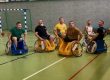
Wheelchair rugby
Wheelchair rugby was created in Canada during the 1970’s. It was introduced in the paralympic games in 1996. This sport is played on a basketball playground with a specific ball which looks like a volley ball.
The players have 2 objectives: cross the opponent’s team goal line with the ball while preventing the opposing team to do the same thing.
Collisions are part of the game. It is why the player’s wheelchairs in competitions are equipped with a rigid shell, anti-swing wheels, and a double bumper.
Wheelchair basketball
Wheelchair basketball is derived from traditional basketball. The biggest wheelchair basketball teams show spectacular speed and precision. This sport combines stamina and strategy and demands a certain agility to move around in a wheelchair. You can test it without hesitation if you wish to challenge yourself!
Sitting volleyball
Sitting volleyball also demands quick movement synchronisation to move with the wheelchair and interact with teammates. Just like the other sports mentioned in this list, it showcases the power of teamwork. If there is a sitting volleyball club near you, try it out, you will not be disappointed!
Other adaptive team sports
The sports we mentioned above are the most widespread practices in France but the list is far from being over.
Among the other sports, we can for example talk about:
- Boccia, which is either played in singles or in a team;
- Goalball is a paralympic sport made for visually impaired or blind people
- Blind soccer is a soccer variant in which players must score with a ringing ball;
- Hockey on a sled
- Etc.
A list of individual adaptive sports
Adaptive swimming
Adaptive swimming offers the opportunity to exercise one’s whole body, just like traditional swimming. Athletes practice in different categories depending on their disability. The swimming techniques and the equipment are of course adapted depending on the categories.
Wheelchair tennis
Wheelchair tennis has been a paralympic sport since the 1980’s. Para tennis is accessible to all people suffering from a disability, whether they suffer from a motor disability or are partially deaf. Find out for instance about Léa’s exploits!
Cycling
Cycling is also adapted to the different types of disabilities. There exist several types of bikes to practice: hand bikes, autonomous bicycles or ones that are attached to the wheelchair. They allow speed enjoyers to practice this discipline leisurely or competitively.
Wheelchair fencing
Fencing can also be practiced if you suffer from a disability. Wheelchair fencing is a paralympic sport which applies to different types of disabilities. This practice demands once again an optimal wheelchair mobility and strategical and technical skills to use the épée, the foil and the sabre.
Other sports to practice on your own
Here is an additional list of other adaptive sports:
- Athletics;
- Wheelchair archery;
- Power lifting;
- Downhill skiing;
- Hockey;
- Adaptive dancing;
- Etc.
The list of adapted sports is long and is constantly evolving. Be that as it may, sport remains an excellent way to broaden the horizon of people suffering from a physical or a mental disability. In such a context, the FreeMoovin’ is a true revolution. This plastic sport wheelchair allows anyone to push their limits. If you are part of an adaptive sport association or a private individual and you are looking for a solution to practice an adapted sport without investing a very high amount of money? Then call us at 04 73 24 60 86 if you want more information on this topic!
sources
Monparcourshandicap-quel sport pratiquer avec un handicap ?
Gouvernement-faire du sport un vecteur d’inclusion