

Obesity is a public health problem in France which has important consequences on the medical and economical plane. According to the Haute Autorité de Santé (High Authority on Health), it affects more than 17% of adults. According to a study made in 2015 and 2016, the prevalence for teenagers is only at about 6%. Sport practice remains an excellent help to mitigate the consequences of obesity on health. This article goes over the assets of adaptive physical activity regarding obesity. It also presents different examples of APA.
Why does adaptive physical activity have such an impact on health in the case of obesity?
For an adult, obesity is defined by a BMI superior to 30kg/m². Waist size is also an essential criterion to determine if obesity is abdominal or central.
APA (adaptive physical activity) is part of the therapy proposed to people affected by obesity. It must be said that sport has numerous benefits for preventing obesity or in the case of weight excess – when paired with a diet. Here is a short presentation of the activities.
Mitigating chronic diseases
Today we know that obesity is a real risk factor in contracting a chronic disease (type 2 diabetes, cardiovascular diseases, cancers).
Fortunately, APA allows to limit a certain number of these physiological and mechanical workings.
Energy consumption to favour weight loss
Obesity is characterised by an imbalance between calory provision and energy consumption. Body mass is higher and it goes hand in hand with an increase in basal metabolic rate.
However, by practicing an adaptive physical activity, one can improve their total energy consumption and take back control of their body, causing a progressive weight loss.
Limiting abdominal fat
Abdominal fat often goes near viscus for people suffering from obesity. Not only does it raise the risk of contracting cardiovascular diseases but it also creates metabolic complications. Reducing waist size also makes it possible to avoid hypertension or heart disease.
A benefit for joints
For people suffering from obesity, joints are often mistreated. Body pressure is intense on the back, the hips but also on the knees and this can lead to osteoarthritis.
Better mental health
You certainly know that sport practice goes hand in hand with good mental health. And this also stands true for people suffering from obesity.
Thus, adaptive physical activity is precious for an overweight person. It contributes to:
- a better sense of self-esteem
- getting rid of the feeling of isolation which is often felt by overweight people
What are APA’s benefits for people suffering from obesity?
Sport practice has numerous advantages for overweight people.
Weight loss
The practice of an adaptive physical activity – when paired with a diet – allows a significant drop in weight. The Haute Autorité de Santé estimates that a weight loss from 5 to 10% already gives significant results regarding the mitigation of heart or metabolic diseases.
Going back to a better mobility
Adaptive physical activity improves the flexibility of an obese person. Not only is the body aligned but the joints suffer less.
Endorphin release
Sport practice is perfect to find a sensation of well-being again (stress relief or even exhilarating effect). It has an effect on the mood and limits depression and anxiety symptoms.
People suffering from obesity who practice a sport develop their social skills again. What is better than positive connexions to have a good sense of self-esteem?
What are the physical activities that are adaptive to obesity?
Walking, doing yoga, DIY, gardening, etc.: There are numerous interesting adaptive physical activities for people suffering from obesity.
Stamina and muscle reinforcement
Bodybuilding – along with adaptive cardiovascular activities – is an excellent support to adjust one’s metabolism. It helps overweight people to increase their muscle mass all the while losing fat.
Sports adaptive to joint pain
Swimming remains an activity with very little impact on joints. It allows to improve dexterity and muscle strength. Another flagship adaptive activity is cycling with electrical assistance. Joint collisions are mitigated, specifically for the hips and the knees.
Walking
Walking is accessible to everyone and allow for energy consumption. It helps improve mobility without putting pressure on the joints.
Adaptive yoga
Here is a discipline that adapts to the person suffering from obesity. It favours dexterity and muscle strength.
Soft gymnastics
Gymnastics is also an excellent idea to regain joint mobility and to strengthen oneself without altering the joints. This group activity adapts to everyone, no matter the physical limitations.
Team games
Starting adaptive physical activity again demands considerable effort. The obstacles to pass are numerous: a prolonged sedentary lifestyle, a weak physical condition and breathlessness.
The practice of team sports is a good way to get rid of isolation and to get some mobility back.
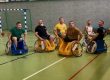
Certain activities like wheelchair handball or XIII wheelchair rugby allow some people to partake in a leisure activity with pleasure all while overcoming these physical and psychological obstacles.
Playmoovin’ wheelchairs were made with these principles of mutual support and inclusion in mind.
These easy-to-move and user-friendly plastic wheelchairs help people overcome their lack of self-confidence or the fear of the external judgment. Everyone is on the same page and use their torso as much as their arms.
Are you a sport-health house, a sport federation or an organisation dealing with obesity? Our wheelchairs can help galvanise people suffering from obesity, so call us at +33 4 73 24 72 47.
Sources:
France Assoc Santé-activité physique et obésité
HAS-Surpoids et obésité : L‘activité physique pour votre santé
HAS-Prescription d’activité physique et sportive : surpoids et obésité de l’adulte