

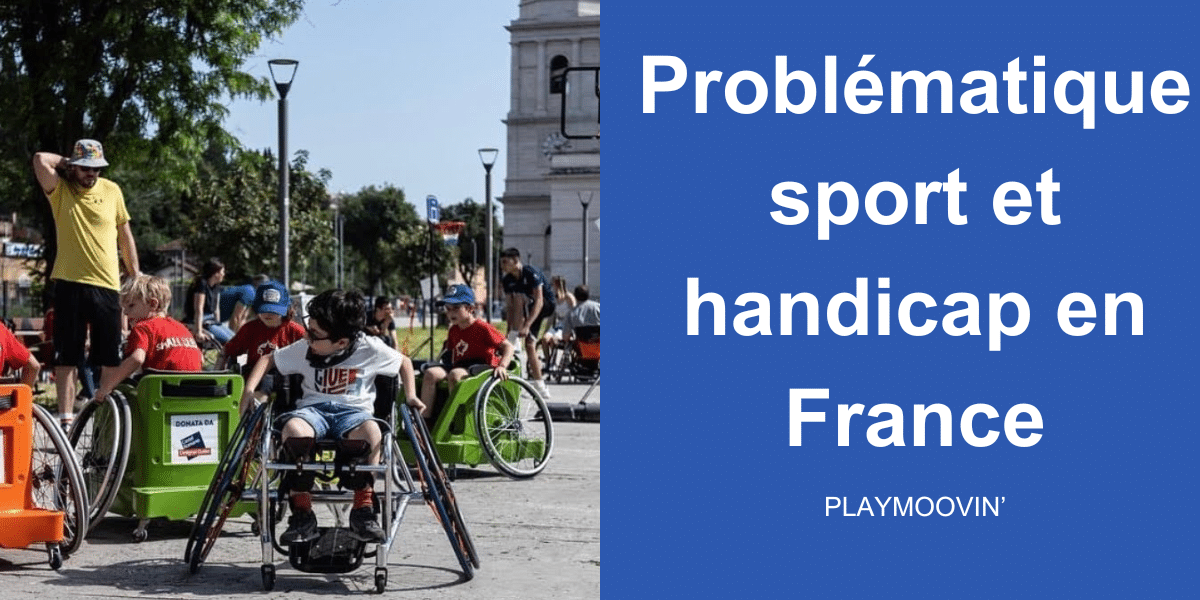
What is the status of parasport in France today? What challenges are left to tackle? This article goes over the issues with sport and disabilities in different ways.
Parasport in France: State of play
According to a 2021 DRESS report (Research, Study and Statistic Evaluation direction), there are more than 6.8 million people who are limited in their sensory, cognitive, or physical functions.
However, according to governmental data, 48% of them do not physically exercise.
The number of members of the French parasport federation is proof of that (35 000 members). This figure shows that the concept of disability remains an issue in sports. We are developing this point below.
The issues with sport and disabilities in 3 points
Find out here about the problematic elements when we talk about sport and disabilities in France.
A sometimes-difficult access to infrastructures
The main problem regarding sport and disabilities is most certainly related to the accessibility to adapted infrastructures. Some cities are well-equipped but in rural zones or in smaller towns, there is a lack of equipment and room to welcome people suffering from disabilities.
Let’s take XIII wheelchair rugby as an example. You will have no trouble finding a club in Paris or in the vicinity but if you live in a small village like Vire in Normandy or Lampion in Britanny, it will be more difficult.
It must be said that transport is also an important obstacle for a person suffering from a disability. Public transports are not always adapted to disabled people. Regarding the transport cost, it is prohibitively high for them as well.
A lack of equipment and tutors
In addition to the problems we talked about earlier, it has to be known that a lot of sport teachers are neither made aware of issues related to disabilities nor are they trained to welcome and supervise these people.
It can lead to problems in elementary, secondary high and high schools.
A limited practice in educational environments
The inclusion of children suffering from disabilities in school in physical activities is still very limited. Numerous children do not even take part in sessions and this is marginalising them.
Numerous measures were fortunately taken to mitigate the problems related to parasport. The sport and disability national strategy is one of the answers to this problem. Let’s examine those measures more closely.
The national strategy in response to the issues related to parasports
The prime objective of this strategy is to create an inclusive environment accessible to all people suffering from disabilities.
The sport and disability national strategy advocates especially the pooling of specialised sport equipment between different clubs. An effort is also made to make the infrastructures more accessible.
Raising awareness of disabilities is one of the pillars of the sport-disability issue. As a sport wheelchair manufacturer, we are completely committed to this cause. We wish to raise awareness among the most people so that disabilities are understood and acknowledged.
The sport and disability strategy also creates solutions to a delicate situation: the training of sport teachers. Lifelong education programs are accessible online and are developed by expert supervisors.
To improve on the inclusion of young people suffering from disabilities, the practice of parasports is accentuated during scholar and extracurricular periods. Other programs were also organised to integrate young disabled people in sport classes.
Lastly, the Paris paralympic games are a unique occasion to accentuate the efforts. Media coverage of this event contributes to change the perception of disabilities in French society.
Measures were taken to reduce the issues on sport and disabilities but the road ahead is still long. It requires a collective mobilisation and we are proud to contribute to it. All of this contributes to France becoming a sport inclusion model in the future.
Sources :
DRESS- le handicap en chiffres


