

Do you want to help new enthusiasts discover quad rugby? Today, PlayMoovin’ offers to focus on this parasport activity. Find out about the rules, the equipment, and the educational activities that can be organised to better grasp the concept of wheelchair rugby.
Quad rugby: what are the rules?
Quad rugby is also called wheelchair rugby. It is part of the combat sports that people who are affected by a disability targeting all 4 limbs have can practice.
Small history of quad rugby
Quad rugby was created in 1977 in a rehabilitation centre by a group of tetraplegic Canadians. They were either soldiers or elite sportspeople and they wanted to rediscover the sensations of commitment and cohesion. Despite everything, the nursing staff did not have anything to offer other than table tennis.
Quad rugby team composition
In quad rugby, the players are attributed a number between 0.5 and 3.5 points, depending on the gravity of the disability and the limbs it affects. Specialists are charged with the evaluation of the players’ physical conditions as well as their abilities with their arms, hands, and torso.
In order to promote equity, each team must have a maximum of 8 points on the pitch:
- The players who have a score between 2.5 and 3.5 points are called “big points” and can carry the ball. They are meant for offense.
- The players who have a score between 0.5 and 2 points are called “small points” and must block other players. They are meant for defence.
Each team can be mixed and can have up to 8 substitutes.
Wheelchair rugby rules
In a rugby game, 2 opposing teams of 4 players play for 4 periods lasting 8 minutes each. The game starts by a jump ball at the middle of the pitch. Game time is effective: the timer stops with each goal, foul and each time the ball goes out the pitch.
Half-times take place between the periods, they last for 2 minutes at first then go up to 5 minutes. “Equipment” times can also be requested by the players in the case of technical problems (flat tires, detached straps, etc.).
There is not substitution limit but they remain possible only when a foul takes place or when the ball goes off the pitch.
The game takes place on a basketball playground with the following dimensions:
- 28 meters in length
- 15 meters in width
The goals are represented by two cones separated by 8 meters. Inside the 8 by 1.75m restrictive zone, only 3 defenders can block. Strikers cannot stay in this area for more than 10 seconds. The team who scores the most points wins the game. The ball can be thrown by all means and in all directions. For the team to score, the player holding the ball must go beyond the goal line with at least two of the wheels of their wheelchair being beyond said goal line.
The player holding the ball must dribble at least once. It can pass the ball every 10 seconds.
The opponent can take the ball being held on the knees.
Bumps and contacts are inherent to the practice. However, grabbing an opponent with one’s hands is forbidden and so are excessive contacts that can harm the other player.
Wheelchair rugby: parasport equipment
Quad rugby remains a true contact sport just like XV or XIII rugby.
A round ball
In quad rugby, players use a round ball, not an oval one like one might imagine. It is a mixture of several sports:
- basketball wheelchair;
- football;
- hockey.
A manual sport wheelchair
There exist different types of wheelchairs to play rugby.
Initiation or awareness wheelchair
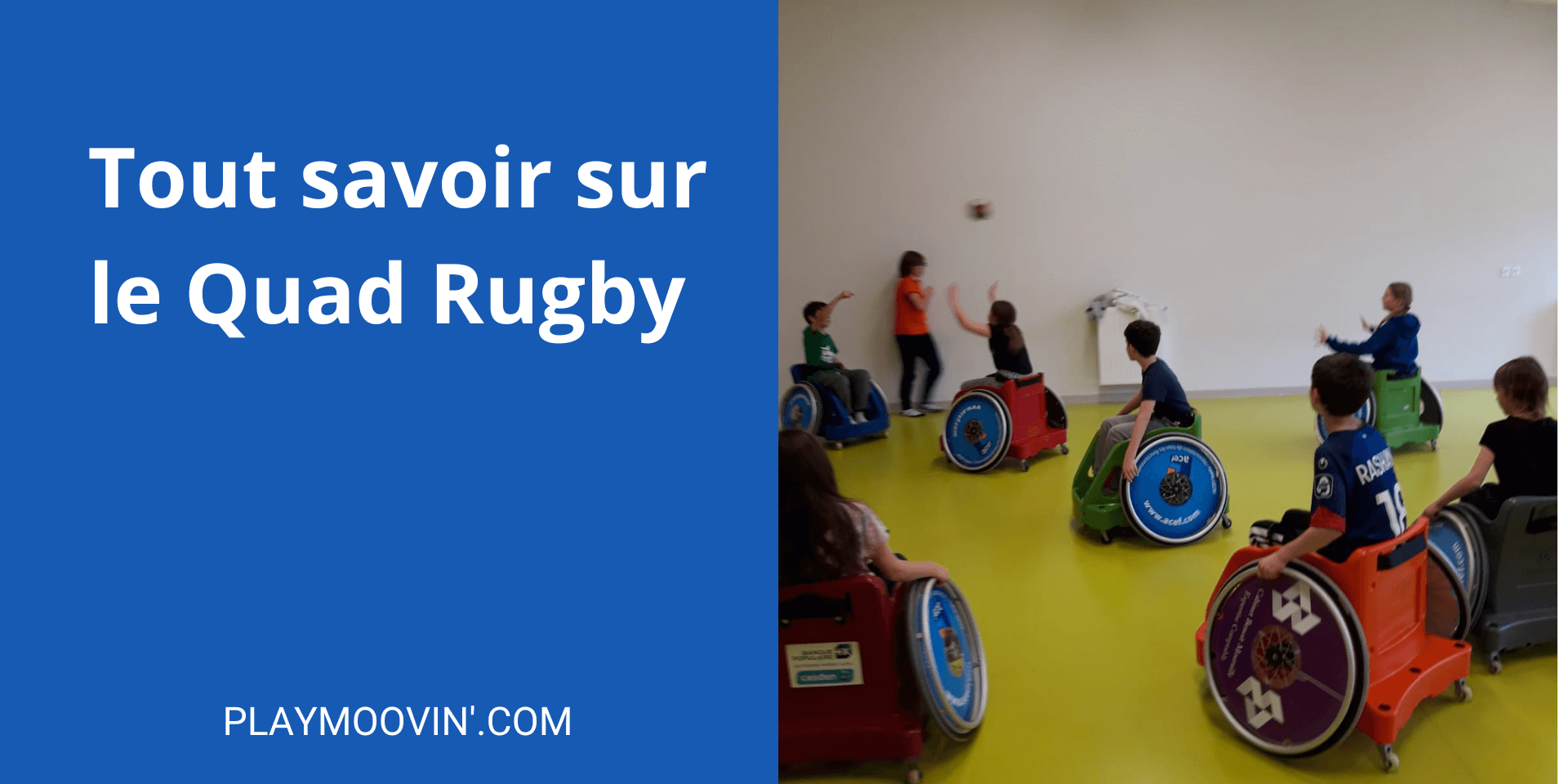
The FreeMoovin’ is the perfect sport wheelchair for parasport initiation and awareness sessions.
It is composed of a rigid and solid plastic case. To guarantee maximum security, it is also equipped with:
- an anti-swing system;
- support straps.
This wheelchair is approved by the Study and Research Centre for the Equipment of Disabled People (CERAH in France).
The rugby parasport stade toulousain and other parasport clubs use these wheelchairs to raise awareness of disabilities among young people.
Competition sport wheelchair
Quad rugby is a full contact sport. On that note, it is known as “murder ball” in the USA.
In national and international competitions, collisions and athlete reversals are part of the game. Sport wheelchairs are made of a rigid material. They are equipped with:
- an anti-swing system
- a secure bumper
A defender’s wheelchair is different from a striker’s wheelchair. Players in the front have apparels that are as fast as they are mobile. They all have a round bumper which limits collisions. On the contrary, the defender’s wheelchairs have an ergonomic front which facilitates the blocking of opposing players.
3 practical initiation practices for quad rugby
Do you want to initiate children or adults to quad rugby? Here are few situations that can help you get started with wheelchair rugby before jumping headfirst into competitive play.
Situation number 1: learn to handle a wheelchair
Here are a few examples of simple wheelchair handling for first beginner sessions:
- moving forward and backward;
- weaving around cones;
- handling the wheelchair while picking up speed;
- picking up the ball when being still;
- learning to bounce the ball;
- etc.
To make it easier to grab the ball, the first sessions can be organised with the use of a foam ball in mind.
Situation number 2: learn to score
The pitch is a 15m square and there are two goal zones on the side. Each player’s mission is to:
- counter the opposing team
- score as many goals as possible
This parasport activity is particularly interesting to learn how to move about and to score in a wheelchair.
Situation number 3: 5 pass game
The 5 pass game is the ideal educational game to start playing quad rugby and learn to cooperate.
Each 4-player team must achieve 5 consecutive passes without the ball falling in the opposing team’s hands. Strikers move on their wheelchairs all the while passing the ball to each other.
On the other hand, defenders must take the ball. They have to impede on the strikers’ progression by interrupting their trajectory. The team who wins is the one that scores the most points.
Quad rugby becomes a common game to promote inclusion and cohesion.
Indeed, what is better to grasp the notion of disability than presenting it through a game? Do you want to make your students or your collaborators play wheelchair rugby? We are here to meet you and support your project so call us anytime!