

Good day to all the readers who want to discover wheelchair rugby! This article will be a bit different from the others on the site so I will quickly introduce myself first.
My name is Lucas and I am currently doing a 5-month internship in PlayMoovin’ in order to manage the translation and the writing of a large variety of content regarding the company. I am doing this in the framework of my master’s degree in translation and writing (MRT or Métiers de la Rédaction et de la Traduction).
Thanks to this opportunity, I have had the immense pleasure to take part in the company’s intervention in the Teilhard de Chardin secondary high school in Chamalières along with Jonathan Hivernat – the French wheelchair rugby team captain who competed in the 2024 Paris paralympic games. I am going to summarize this afternoon and talk about my impressions and feelings.
Context and first part of the intervention
For context, PlayMoovin’ provided 10 parasport wheelchairs to the Teilhard de Chardin secondary high school in the framework of the project “Changer le Regard sur l’Handicap” (Change how people view disabilities). For 3 months, the students discovered wheelchair sport and had the opportunity to try wheelchair rugby. This educational cycle was validated by the academy its objective is to put a new form of sport practice into the light and display values of tolerance and inclusivity because everyone is on the same page. Moreover, this indirectly allows them to learn about disabilities and change their point of view on the topic. This event is the pinnacle of that whole process and it ended on a very high note.
After a lunch with the PlayMoovin’ team, along with Jonathan and the communication team and members of different associations.
Jonathan was kind enough to let me take his competition wheelchair for a spin – something I had never have the chance to do before. It was very pleasant to handle.
It is thanks to the feelings I had while rolling that I started to truly understand the interest of putting able-bodied people in wheelchairs. If we put aside the evident aspects of sharing, inclusivity, and equality in sport practice, I found out about a more concrete aspect to the practice and I discovered a new kind of pleasure while playing.
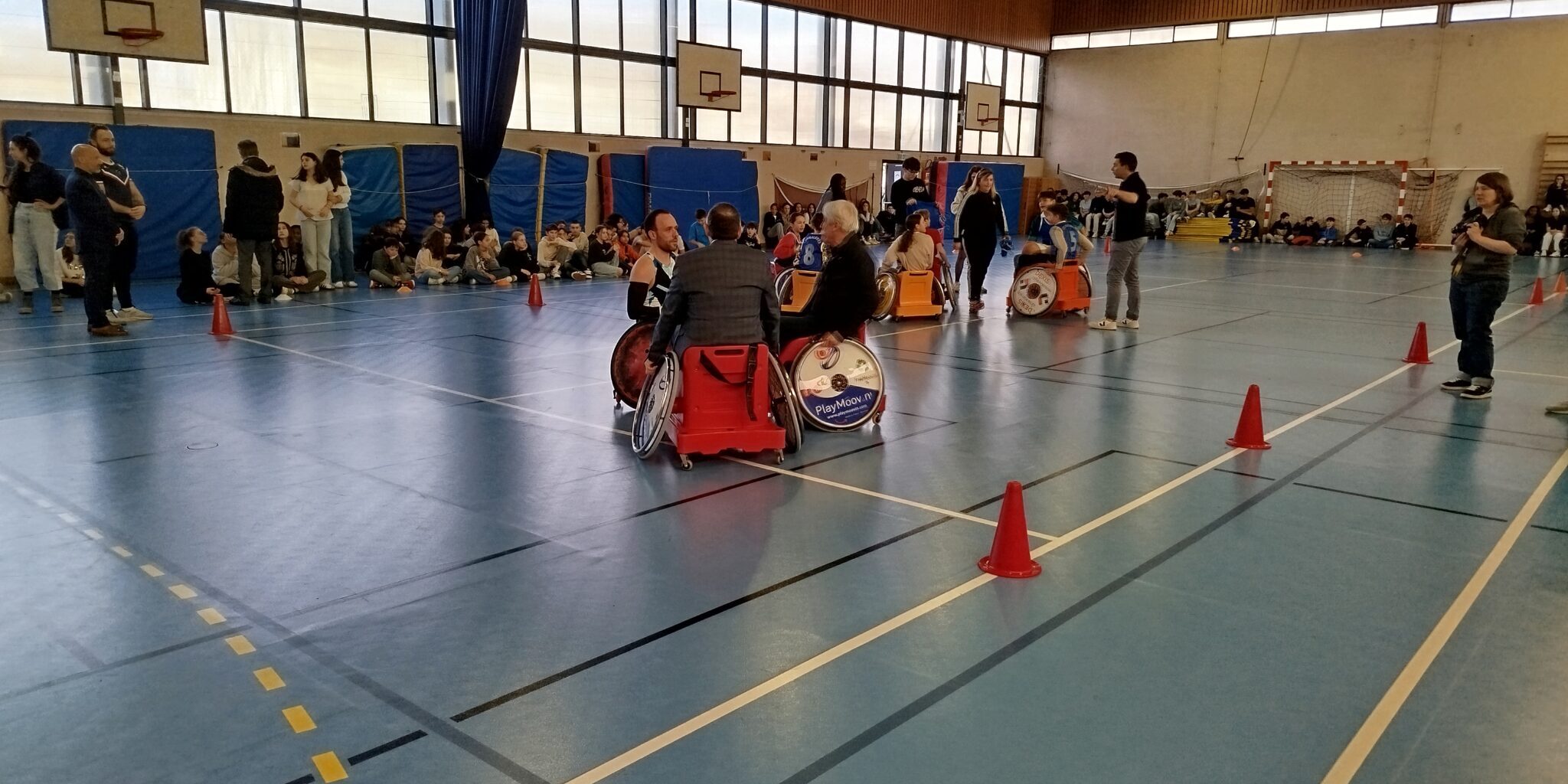
A few student classes then came to gymnasium for the beginning of the activities. The event started by speeches of all the people involved in this superb project from PlayMoovin’, the secondary high school, the département and the region.
After the speeches, the students had the occasion to go on the field to play wheelchair rugby and compete with Jonathan. I am going to use this opportunity to talk about the rules of wheelchair rugby.
The wheelchair quad rugby
Wheelchair rugby is played on a basketball pitch with a round ball in this version of the sport (there is also the XIII wheelchair rugby). There are 4 players in one team: two blockers defend, try to retrieve the ball and block opposing players and two strikers who pass the ball forward and slip through the defenders to score a touchdown.
Only quadriplegics – people being affected by a problem on all 4 members – can participate to official competitions. Everything is regulated by a point system which was established according to the severity of the disability so that everyone can be on the same page while playing.
I am not going to enter too much details because I do not want to be too long about it but I encourage you – dear reader – to look into it if you want to discover wheelchair rugby. To this end, I will put several sources on this topic in this article’s bibliography.
Interactions between students and Jonathan
At the end of this play session, Jonathan explained why he came here while encouraging the students to ask him questions. He chose not to talk about his career because he did not see how it was worth it. He preferred showcasing values of inclusivity, sharing and mutual aid he wishes to pass to younger generations.
Students could then ask him questions they prepared ahead of the event – which proves they were committed to this project. I have to admit that I was pleasantly surprised by the amount of interest and commitment the students showcased.
Important topics were tackled through these questions and particularly the daily difficulties that disabled people can face – in particular regarding the accessibility to public infrastructures. Several interactions were focused on Jonathan’s relationship to wheelchair rugby – from the beginnings to his intensive training.
One question moved me regarding the discriminations he suffered from when he was younger. Jonathan explained that he faced difficulties when he was in secondary high school because a lot of his friends turned their backs on him when his illness broke out. However, he also talked about how what he went through made him tougher and that he learned a lot from it.
I think that this speech was very touching, full of great tips and hope. His status allows him to pass powerful values of tolerance, help and sharing through the practice of his sport and his fame.
Second play session and final thoughts
After these interactions full of positive energy, a second play session took place. I was impressed by the number of students excited to join Jonathan on the pitch to put in practice what they had learned on the PlayMoovin’ wheelchairs.
I also had the occasion to take part in this and test the company’s wheelchair for the first time. I was very pleased to handle the Freemoovin’ as it is robust while being easy to handle and flexible. The handling was intuitive – especially for someone who had never tried it before – and it was easy to take sharp turns. I quickly got caught up in the game and tried to block in defence and pass the ball forward to score.
PlayMoovin’s objective is not to offer high end models, therefore a comparison with a professional sport wheelchair is useless and it is something I understood while talking with my colleagues. The objective he is to make so that everyone can play and that is why PlayMoovin’ offers a cheap and robust wheelchair.
Finally, trophies that were made for the occasion were delivered to all the major collaborators of this project and student classes took photos with Jonathan and then left. The afternoon ended with a small buffet with some project collaborators. This was the occasion to joyfully chat and look back on the three-month project and the event that ended it.
I am delighted to have taken part in the culminating point of this whole passionate project. Taking part in this event allowed me to step away from my laptop and directly see the impact that PlayMoovin’ can have on the development and the democratisation of “universal” wheelchair sport. This immersion allowed me to discover wheelchair rugby, heighten my motivation to help PlayMoovin’ to the best of my abilities and get more satisfaction from my work.
I would like to express my warmest thanks to Christophe Pradelle and Sébastien Passemard from PlayMoovin’ for bringing me along for an afternoon I will not forget anytime soon and for supporting me to the best of their abilities during my internship. I would also like to thank Jonathan Hivernat who – aside from his inspiring speech and impressive performance – took the time to talk with me with kindness and curiosity which allowed me to discover wheelchair rugby. Finally, I would like to address my thanks to all the other people that collaborated on this fantastic project, either from the region, the département, and the secondary high school. Thank you for contributing to change the way people view disabilities and for sharing a common vision of inclusivity and sharing.
I also would like to thank you dear reader and I will see you next time for a new article!
Sources and interesting links to further research
My personal experience of the event (sorry, no available link, I do not have a Wikipedia page)